Archive for the ‘General’ Category

Evolution not Revolution

Monday, March 21st, 2005

Just some thoughts I’ve had since our class on thursday. It seems like at first glance, a lot of these things that are taking place on the internet and otherwise are huge leaps from what happened before. But I feel like on closer inspection, many things which at first seem to be wildly different, are just familiar things projected into a very slightly different domain. It reminds me of the nature of ‘discovery’, often what are touted as new discoveries are just incremental improvements.

It may seem weird to us right now that people are purchasing virtual land for real dollars, but it must have seemed equally weird when people started buying futures on the stock market, liability insurance against things which will never happen. However those things are natural outgrowths of speculative stock trading, and fixed liability situations.

It’s also important to remember that just because something is touted as the way of the future, does not mean everything changes overnight. The new and old often co-exist for long periods of time, and who is to say which will win out in the end (whoops if you bought a laserdisc!).

I was reminded of this while I was reading this Reporter (I know… I know…) article which I happened to be reading in the back row of my class.

In reference to installing wireless access points in classrooms:

Masi said that some professors have requested wireless access be not available in classrooms, for fear that it would lead to a modern equivalent of students reading a newspaper in the back row.
Reading Novels on your Mobile

Saturday, March 19th, 2005

The new addition to the paperless society, you can now read novels on your cellphone in Japan, (soon coming to north america). It seems to be picking up in Japan, in the article they even say that a lot of people are reading novels on their mobile at home????????? I don’t know if it is easier to read Japanese characters in a small screen than it is to read english or french, but I could hardly imagine myself reading a whole novel on my cellphone where not even a whole sentence fit on the screen.

Web Check in

Monday, March 14th, 2005

I recently flew from Halifax to Montreal on Canjet (a few hours ago, actually) – thankfully it wasn’t planned to be jetsgo! Canjet is offering a new service where passengers can “check-in” online from their own home up to 12 hours in advance up to one hour before departure. Passengers must have a printer connected to their computer; they print out the boarding pass and upon arrival at the airport head straight for security (if they don’t have any luggage, of course) – no need to wait in the check in line.

I know airport lines are annoying, but the ironic thing is that I have never seen CAnjet’s line be more than 3 or 4 people long… have a little patience! If we prefer to spend a few extra quality minutes with our computer to check-in for a flight instead of waiting 5 minutes to have a little contact with an airline employee, I have to wonder what society is coming to. I notice that more and more, people are opting for choices that involve less interaction with other people, especially unfamiliar people. This relates back to our conversation in class last week about our need for order and familiarity.

Electronic wasteland no longer in Nova Scotia

Monday, March 14th, 2005

The Daily News, a newspaper in Halifax, recently ran a full page photo/article on Nova Scotia’s plans to ban electronic material from landfills. As of January 1st, 2006 things like: televisions, computers, scanners, cell phones, VCRs, printers and blackberries will no longer be allowed to make their permanent homes in Nova scotia landfills.

There will be a surcharge icluded in the original price of the electronic product when you buy it, which will help the manufacturer pay for the costs of recycling the product. Manufactures will be responsible for the recycling and won’t be allowed to charge the electronics users anything at the time of drop off for recycling, this is why the surcharge will be tacked on to the original price. The products will either be recycled or reused, but most importantly the harmful toxic substances of these products will be removed from landfills.

Details haven’t been completely worked out, but it sounds like this program is a defiinite go ahead – very ambitious, but very admirable! I’ll bring the paper clipping to class Tuesday – remind me to show you!

Food Blogging

Monday, March 14th, 2005

I finally ran across a blog I want to post about, it was mentioned in slashdot this morning. It’s by the head of a blogging company called fotoblog, and it is simply a collection of pictures of what he eats each day. For some reason (possibly because I’m hungry) this struck me as a pretty cool idea, and I browsed through a few pages of his meals.

What I can tell about him:

  • he is not a vegetarian
  • he eats out quite a lot
  • he seems to eat a decent variety of foods

I really enjoy food, and a lot of things I enjoy doing are also centred around food, so I can imagine if I had a similar record of what I was eating, it’d probably be a fairly complete record of important things. Anyways, it’s an interesting idea.

Food Blog

Computer Plumbers

Monday, March 14th, 2005

I ran across a BBC piece about people being trained to become computer plumbers. Now it might seem like a little bit of a juxtaposition, we often think of plumbing as ‘low-tech’ and computers being ‘high-tech’, more of that up-down dichotomy I suppose. Of course the reality isn’t much different, people often recruit my help when their computers get their pipes clogged so to speak.

I like the term because most people seem to fundamentally believe they understand plumbing: after all, it’s just things flowing through pipes. Nothing mysterious about that. Compare this to computers, which people seem to treat as systems of vast complexity, never to be understood. An attitude like that tends to make people start randomly clicking things, and then giving up in despair when things don’t work. If one goes with the attitude that things are usually happening for a reason, it’s generally a lot easier to fix things.

On a side note, we don’t learn about computers in computer science. Computer science is called information science or something like it in most other languages, which sounds a lot different. In reality, we primarily learn a funky subset of math, and it just happens that computers have a lot of applications of the funky math. Of course, it’s not that uncommon for computer nerds to gravitate towards things like computer science, so the person in computer science may also happen to have the knowledge to be able to remove whatever Kazaa installed. It’s interesting to note that there are people who are in computer science who have no knowledge about, and little intersest in, computers. Often they are doing management minors (ew).

So, Computer Science: the mathematical study of theoretical plumbing systems. Knowledge of plumbing not required.

Computas, society ‘n natur, dogg

Sunday, March 13th, 2005

Gizoogle is a cross between Google and a dictionary of African American Hip Hop Vernacular. It’s a search engine that translates its results into “gansta-speak” a la Snoop Dogg. The results are entertaining (to me anyway) and the site has received quite a bit of coverage. Here is some coverage from the Washington Post. The site is another example of the how the net shifts our definitions of content, intellectual property, and context. Here is free tool that allows you to take any webapage and make it completely different, in a way some people might be offensive.

Try translating our blog. The caption under the second to last cat photo is particularly funny.

ICT and war

Saturday, March 12th, 2005

Programs have become very specialized. There are channels devoted to golf, cooking, nature, documentaries, you name it. And with technology, we have been able to connect worldwide and are able to view programs from other countries. It just strikes me as odd, that someone can watch a cooking show, then change the channel to watch the war (real time), and then when they’re bored, switch to another channel. It’s like we’re getting something very real and devastating, mixed up with entertainment. Any thoughts on this?

Which country ranks highest in ICT?

Wednesday, March 9th, 2005

Last year it was the US, but this year, the US went down to 5th place, any ideas why? I’m not quite sure. Canada always seems to compare itself to the US in terms of technology, but why do we do that? Let’s start looking at what other countries are doing too. Click here to see the country rankings. They don’t mention how the study was carried out, or their methodology. I think it was done by the World Economic Forum. Actually, I think you have to buy it the report online 🙁 What’s interesting to note, though, is that the authors confirm a trend in narrowing the digital divide between developed and developing countries…

legal construction of online journalism

Monday, March 7th, 2005

Here is an interesting article about the legal difference between traditional forms of media and new online media. Aparently the right to protect confidential sources is only legally protected in the print media. Apple Computer is trying to get online sites that publish rumours about Apple products to divulge their sources. So it’s not quite as important as protecting government sources but I still think it’s an iteresting illustration of the differences between media. This legal discrepancy will have to be remedied eventually.

My Evolutionary Art Experience

Monday, March 7th, 2005

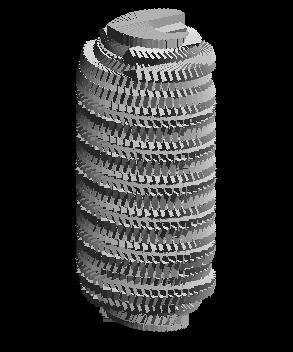
While reading the “In the Library of Form” chapter from “Out of Control” my curiosity level rose too high that I had to stop reading and switch to Google to find one of these evolutionary art programs, and starting my own search through Borges library of shapes. I downloaded Andrew Rowbottom’s program “Form”, which is rather old (required PC is 386 with 2MB of RAM), but easy to use and works well. After a few hours of search through the universe of shapes, I wanted to share with you one of my “greatest” findings: a multi-storey version of Montreal’s casino, evolved out of these useless shapes. Maybe I should submit my model to loto-quebec… they’ve been talking about expending the casino for a while :).

From: To:

And if they ask for the details of the blueprint it is simple as that:

// MTL’s multi-story casino blueprint
a_spine=box < -87.0838 , -680.583 , 892.81 > stack -39.4158 in 1.6423% grow -581.552 twist -32767;
tweeny_bit = sphere ( 409.017 ) stack -36.4661;
tweeny_bit & [a_spine] stack -628.25 in 20.5538% twist -2123.08;
end;

Ok enough playing… now it’s time to get back to the reading…

Computing with Entropy

Sunday, March 6th, 2005

An interesting concept is entropy. Entropy is the tendency of things to become disordered and chaotic over time. For example, if you have a bottle of red dye, and a bottle of water, and you put a drop of red dye into the bottle of water, the red dye will start off concentrated, but then will slowly diffuse through the bottle of water, until the whole bottle is just a little bit more red. This same concept applies to everything: things are (in the long run) becoming more disorderd. Entropy is even used to determine which way time is going: time is going in the direction of increased entropy.

Now, as my ‘end of the universe’ post pointed out, we don’t have a way to reverse entropy. What’s fun to think about, is how we use things as they’re falling down the order ladder towards chaos. For instance, the sun fuses hydrogen together, and the universe loses a little bit of matter it will never recover, as it is converted into energy. Uncountably many times this happens, and those little photons travel about a hundred million kilometers to earth, and heat up some water molecules just enough, so they turn into vapor. The vapor rises, and collects into clouds, and then falls in rain or snow. The rain and snow collect in rivers, and eventually we dam some of them up, so we can let the water fall down a few hundred feet and turn a crank so we can excite some electrons and get them to start flowing. This flow we transmit hundreds of miles through transformers and wires, until it gets to our homes. At this point we push some of the electrons through little gates and switches (I can just imagine them sloshing through pipes) as they race towards chaos (in this case, the ground). So we turn them this way and that to fit with our abstract concept of ‘numbers’, and then depending how the electrons fall through our electron maze, we can say, “ah, 2+2 IS 4”, and then the electrons fall through the chip, into the ground wire and find a companion proton somewhere in the Earth.

At least as the universe falls towards chaos, we can use some of it to add!

The Facebook

Wednesday, March 2nd, 2005

I felt it was inevitable that someone would post about facebook, so I decided it may as well be me.

Facebook is one of those things that really seems like a huge waste of time, because it is. It is essentially a university directory, where people go and enter in some information and maybe upload a picture of themselves. They then look through the directory to find people they know or have things in common with to add as friends or create groups with. That’s all it is: a fancy directory. However it seems to have taken a hold of some people in quite some fashion. I know some people who check it daily, and who have amassed these huge lists of acquaintances who they are ‘friends’ with. It is truly bizarre.

The members of McGill’s facebook seem to be primarily first and second year students, and seems weighted towards Americans and people who have stayed in residence at McGill. This is likely because Facebook started at Ivy League universities (Harvard to be exact), and slowly spread to other American universities, so when students at universities where facebook is already established notice that new universities have joined, they tell them to sign up so they can be added. Those students at McGill, coming from the states, often live in residence, and tell other people who live in residence about the site, they them sign up, and so on. I was told about it by an American student at McGill in mid-October. Diffusion at work.

I notice Hannah already has an account, but a quick search didn’t turn up any of the rest of the class, nor Prof. Sieber (I found 2 professors when I looked, one chemistry professor, and the other is in education and a residence director). To sign up you need your McGill e-mail address , which I was slightly worried about giving, but I haven’t noticed any spam coming in on my McGill e-mail since, and it’s not as though the e-mail isn’t available elsewhere on the web for bots to crawl.

Watch out, people seem to find it addictive!

mcgill.thefacebook.com

future industry

Tuesday, March 1st, 2005

I’m going to try and write a few more blogs this week to compensate for the ones I missed before the break. It has been so long I even forgot how to login! Someone mentioned something about 3D printers in class today and it reminded me of a slashdot blog I read earlier regarding a printer that makes sushi. Is there anything technology won’t be able to do in the future? Apparently the ink that is used is food-based and the paper is made of soy and seaweed. Can you see 3D printers being as common as personal computers in the future? Would they allow for customization of goods? Think of it – you wouldn’t have to step into another mall again – you could make your own custom barbie dolls as a gift for your little cousins, sitting at home!

The End of The Universe

Monday, February 28th, 2005

Now, the end of the universe is one of those things we could likely avoid thinking about, without too many consequences. However, it is sometimes interesting to consider what might happen a few billion years from now, will the universe start to contract, and eventually squish itself back into a little point before exploding again into the big bang? Or will it just continue expanding forever, until the suns go out, and all is cold.

In either of those situations, you have to wonder what will happen to humanity, if we perchance happen to be there, or to some other intelligent life, if any exists and makes it that far. Is that just the end of all life? It’s somewhat disconcerting to think so.

A fellow named Frank Tipler believes that it’s inevitable the universe will fill up with intelligent life, and that by the time the universe collapses, the ability of life to process information will be asymptotically infinite (as we get closer to the collapse, the closer to being able to process an infinite amount of information), allowing that life to essentially simulate the entire universe again, thus reproducing all of us, and our lives again, in this simulation of what is essentially the universe.

It’s an interesting idea, although I’m certainly skeptical that he bases his theological statements entirely on the bible. It’s interesting to wonder what the world will be like in a few thousand years, let alone a few million or billion.

You can read a little bit about his theory here (Tipler’s site) and here (wikipedia).

Along the same lines, there’s a fun short story by Isaac Asimov that has another ending to the universe:
The Last Question

Population estimate

Friday, February 25th, 2005

Here is a story from AP via the Globe about the UN population estimate for 2050: 9 billion people and mostly in the developing world. Just imagine the earth’s population almost doubling over 45 years, that’s an incredible increase compared to what we have recorded to now. What will the implications be for nature of this population growth? How can technology assist with dealing with population growth?

Maldives Pushes Ahead With Relocation Plan…

Friday, February 25th, 2005

What has been anticipated as now begun… the relocation of islanders.

Yesterday in the news they announced that the Maldives is going ahead with its relocation plan.

The Tsunami has obviously given the spark to Maldives to go ahead with the relocation plan, 40% of the country’s land have been submerged during the tsunami, but the real-problem of the island nations (we all know it) is the rise of ocean due to global warming. The Maldivian government plans to relocate 60% of its people from low-ground islands to higher ground islands.

Maldives have at least some higher-ground to relocate its people but it is not the case for another country with an even more critical situation, Tuvalu.

Tuvalu is a small country in the south pacific composed a a few coral islands, its highest ground is not more than 4.5metres above sea-level. More and more often Tuvalians see their whole country flooded during “king tides” that can reach more than 3 metres above normal sea-level. The last one was two-weeks ago. Tuvalu’s government is now trying to dress a relocation plan with Australia and New Zealand in case of an emergency.

I liked the analogy that the government of Tuvalu does between the “War on terror” and “climate change” in terms of national security.

QUOTE=>

Tuvalu said it understood that for many countries, particularly developed nations such as the United States, national security was now a priority and the island nation supported the war on terror.

Tuvalu representative Enele Sopoaga told the General Assembly that national security was also a priority for Tuvalu, but the threat it faced was not from terror groups or weapons of mass destruction but climate change.

“For Tuvalu and many small-island developing states security should be seen in its multi-dimensional nature. Our national security is threatened by environmental degradation emanating from outside the country,” Sopoaga said.

“The impact of climate change has the potential to threaten the survival of our entire nation,” he said.

<= END of quote So which one are the most threatening WMDs? Sarin or CO2

Paris Hilton’s cell phone

Thursday, February 24th, 2005

I am a not so closet fan of pop culture. One thing that’s driving me crazy is this confusion over the hacking of Paris Hilton’s cell phone. Am I mistaken or was it actually her online database (on T-mobile?) that was hacked, a website that happens to be connected to her cell phone (SideKick)? Either reporters are incurious and are too lazy to understand how the technology works. OR, and this is more likely, it’s more sensational to report on a potentially new vulnerability, the hacking of cellphones that so many people now own. It’s like people worrying that computers, which aren’t connected to the Internet, will get hacked.

Or maybe this story has received so much coverage just because we’re supposed to feel sorry for the celebrities?

Environmental IT Purchasing

Thursday, February 24th, 2005

An interesting link I ran across, it appears to be an environmental checklist by the chief technical officer for the city of Seattle. I find it reassuring that it even exists! It covers goes over how to make environmentally sensitive IT purchases, and has a sort of checklist for effective purchasing, including energy efficiency, toxic materials, percentage of recycled material, as well as how to deal with the computer waste.

Of course, this is a government agency (presumably) asking these questions, and one could argue whether a company driven purely by profit motive would have what seems to be a very reasonable set of criteria.

I can certainly imagine some change taking place if a few relatively large companies had this same set of criteria in their IT departments.

Link (Powerpoint… sorry!)

Mincipal Wifi’s

Thursday, February 24th, 2005

From the NYTimes reporting on Philadephia’s attempt at a municipality–wide wireless Internet network:

“City officials envision a seamless mesh of broadband signals that will enable the police to download mug shots as they race to crime scenes in their patrol cars, allow truck drivers to maintain Internet access to inventories as they roam the city, and perhaps most important, let students and low-income residents get on the net.”

Municipal wireless is at the same time a fascinating experiment in technology diffusion, a scary story of surveillance, an interesting battle between the public and private sectors over who should build the infrastructure and finally, an example of overlaying virtual public space over physical public space at 1:1 scale. As much as I love wireless, I’m not certain it’s a good idea to have my nose buried in a laptop instead of occasionally experiencing the world around me (at minimum, I’d likely bump into the lamposts). But then again, is it any different from the continual connection to the virtual afforded by cellphones and Blackberries?

Wi-fi Networking News has a good round up on munipical inititiatives to create wireless communities.