The Stern report that we blogged about last week was released today. The actual report is here.
The debate in blogosphere is now raging, with 26,113 posts so far.
The Stern report that we blogged about last week was released today. The actual report is here.
The debate in blogosphere is now raging, with 26,113 posts so far.
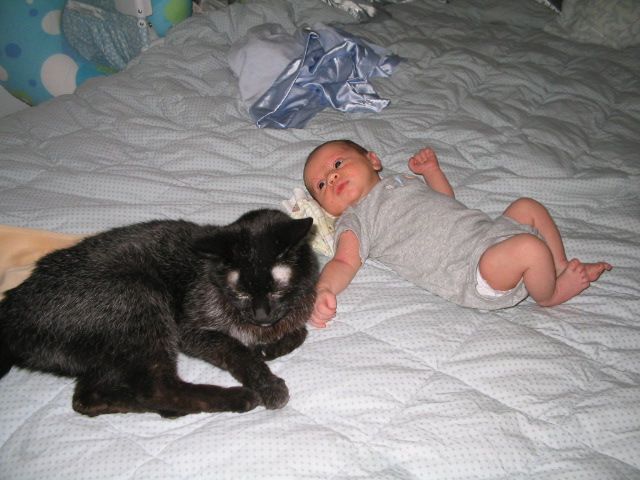
ancient cat; young human.
A UK report will be released on Monday that predicts the economic effects of climate change. It was commissioned by the UK Treasury and conducted by Nicholas Stern, who was a chief economist with the World Bank. The message of the report: Climate change will have disasterous effects on the world’s economy. However, the investments now to turn it around are relatively small and will actually boost countries’ ecnonomies.
Speaking at a climate change conference in Birmingham, [David King, the UK government’s chief scientific adviser] said: “All of [Stern’s] detailed modelling out to the year 2100 is going to indicate first of all that if we don’t take global action we are going to see a massive downturn in global economies.” He added: “If no action is taken we will be faced with the kind of downturn that has not been seen since the great depression and the two world wars.” Sir David called the review “the most detailed economic analysis that I think has yet been conducted”.
A “grid” of smart river sensors will be installed in the Ribble River (Yorshire, UK). The sensors will monitor water pressure/depth and flow and will be used to predict impending flooding.
The article likens the network of sensors to grid computing:
Each node is smaller than a human fist and powered by batteries and solar panels. Each is also accompanied by a computer unit about the size of a packet of chewing gum, which contains a processor about as powerful those found in a modern cellphone.
The sensors are positioned within tens of metres of each other and communicate through Wi-Fi and Bluetooth antennas. This enables them to collaborate for data collection and processing tasks, creating a larger community computer. The same “grid computing” approach is used to connect computers at different locations for distributed research projects.
If the river’s behaviour starts to change, the network uses the data collected to run models and predict what will happen next. If a flood seems likely – because it is rapidly rising and moving quickly – the network can send a wireless warning containing the details.
(Hmm but do the people in Yorskshire know that one of their rivers is broadcasting to a lab in Lancashire? The War of the Roses wasn’t that long ago… 😉 )
The wikipedia community has been asked to come up with ideas of what copyrighted items should be freed and made available to the general public. The wishlist is on a meta-wiki (meta-wikis assist the Wiki Foundation in coordinating wikis, such as wikipedia and wikimedia). Wikimedia has the copyright wishlist, which includes newspaper articles and photographs, 20th century sheet music, textbooks, and academic journals (including Web of Science, JSTOR). Here’s the wishlist for freeing up remote sensed images and vector files.
While perusing the list, I came across a term I’d never heard of before: abandonware. Someone suggested that the copyrights to discontinued software be purchased and distributed under a GPL.
Nice article about Elizabeth May, founder of the Sierra Club of Canada and an “accidental Canadian”.
Carnegie Mellon researchers have developed software to automatically generate 3 D images from 2 D images. Watch the video and see how they even create the 3 D visualization from a painting.
The
Using machine learning techniques, Robotics Institute researchers Alexei Efros and Martial Hebert, along with graduate student Derek Hoiem, have taught computers how to spot the visual cues that differentiate between vertical surfaces and horizontal surfaces in photographs of outdoor scenes. They’ve even developed a program that allows the computer to automatically generate 3-D reconstructions of scenes based on a single image.
…
the Carnegie Mellon researchers will show that having a sense of 3-D geometry helps computers identify objects, such as cars and pedestrians, in street scenes.
More detail, including the downloadable software, can be found here.
Now, if the software could embed geo-references at various points within the image then we could stitch together some high resolution walk-throughs from separate photos that also could be anchored to map locations. Think of the possibilities for flickr! I wonder what would be the minimum number of pairs of x,y coordinates that the photographers would have to submit as geo tags? We could render aerials as well but we’d have to orient the images to maximize the horizontal and vertical. Also, think of the possibility in taking old hand-drawn maps and street scenes. This could be be a wonderful addition to the work already being conducted on draping images onto digital elevation models.
Do science students need to conduct actual, physical experiments in chemistry, physics, natural resources, environment? Or can all science education lab work be done online? This is the question with which eduators and those who accredit science education are trying to grapple.
The arguments for online education (not necessarily an exhaustive list): lack of resources (we have no teachers; we have no labs; we’re poor and rural; we want to home school…), better grades (students are performing better on advanced placement exams to get into university), protection of the student (some experiments are dangerous or are in distant locations) and promotion of student individuality (students can take courses at their own pace, can take more advanced courses than currently offered in their schools or can take remedial courses). One such example of online science education is the Virtual High School, a nonprofit educational institution based in the US that reports to serve 7,600 students from numerous countries and US states.
The arguments against (which are not well-covered in the article): the inability of virtual space to simulate the physical world (e.g., smells, manipulation of substances and instruments), the uneven quality and lack of accreditation of online courses, as well as the dubious connection between doing well on exams and being able to conduct science.
Add to those, the argument by the online content producers themselves that online science in and of itself is insufficient:
Earl W. Fleck, the biology professor who created the virtual pig dissection, believes otherwise. Dr. Fleck began working on the virtual dissection in 1997 to help his students at Whitman College in Walla Walla, Wash., review for tests and to offer a substitute for those who, for ethical reasons, objected to working with once-living specimens.
Dr. Fleck, who is now provost at Hampden-Sydney College in Virginia, said students worldwide found the virtual dissection useful. But he called it “markedly inferior†to performing a real dissection.
Note how this is an example of mission creep in virtual education. What was created for one purpose, an assistance to real world practice, has become an end in itself. This is a real problem in any distance education. The temptation is to think that all you need is a computer and an Internet connection and you can learn everything you need to know. It’s the computer / Internet revolutionary lure. It’s an efficiency argument (why have our own lab when an online course can do it better and utilize the best instructors in the world?). So there is ample justification that a school need not seek investment in its own science education. More important, like textbook sales, online education is an incredibly lucrative market. There is every incentive to package and sell these virtual labs.
So can we conduct environmental science this way? Certainly there are strong arguments for online labs. For example, it’s difficult to do a real world science lab on global warming. Much of global warming research is computer-based anyway, so it’s relatively easy to move the desktop models online so that students can conduct their own ‘bite-sized’ climate change models. One can create similar online labs in water modeling and management, food systems, epidemiology and public health, even in sustainable forestry and habitat conservation. Technically, it’s relatively easy. But what does the student lose by not travelling to the river, taking the water sample, and examining it under a physical microscope?
Believe or not, I’m quite ambivalent. I do research in the use of geographic information systems by poor communities. A lot of the modelling and mapping could be done online and be used to educate people about the impacts of deforestation, air/water pollution, climate change, etc. Poor people in far flung places can be greatly assisted by online courses featuring the best environmental instructors and advocates in the world. But does that mean we need invest in no local teachers nor worry about real world practice in difficult places (say, science education for girls in Afghanistan)? Of course not, but balancing the on the ground environmental education against efficiency / technological razzle dazzle is difficult.
Here’s a nice cat in the town of Deventer in the Netherlands. I like the reflection in the window.

The eco-consumer or community association has a new tool to assuage their guilt over riding an airplane or buying strawberries in January: the carbon offset. Purchase an interest in a tree planting project or fund R&D into climate development mechanisms and, voila, your carbon emissions have been compensated by good works. What with the £60m worldwide carbon market, however, this is becoming a prime area to rip off consumers. So how much do you know about that carbon offset scheme?
Francis Sullivan, a carbon offset expert who led attempts by banking group HSBC to neutralise its emissions, said: … “There are sharks out there who are literally just trying to get money off you. People were offering to sell us large chunks of the rainforest in Papua New Guinea. I don’t think it was theirs to sell.”
Concern is growing that the demand for offsets is allowing projects to claim savings they do not deserve, which are then sold on as “carbon credits”. A tree planting or windfarm project reckoned to save up 30,000 tonnes of carbon could sell an equivalent number of carbon credits for about £3 each. To provide a true carbon saving, the developers of such projects must demonstrate that it would not have happened without the investment raised by selling such credits, called additionality. The saving is then worked out against what would have happened, the baseline.
Mark Kenber of the environmental organisation the Climate Group said: “There are plenty of projects out there that are rigorous and have no problems at all. Then there are plenty that are not truly additional and you could question the baseline used. Then there are suspicions that people have sold the same ton of carbon to four or five different customers.”
Many of these mechanisms are available over the Internet. So you’re just a click away from feeling green. Perhaps you need to pause before you press the mouse.
Okay, it’s been awhile. I’m enjoying my sabbatical in the Netherlands so blog activity has slowed way down. But with my recent upgrade of wordpress I’m ready to get started again. Here’s an interesting presentation on a piece of software that has amazing potential for landscape analysis, scenario planning, and participatory planning.
Let’s say, you’re concerned about the impact on erosion of a particular clearcut. You delineate the area, “build” the bulldozer, run the model, and then measure the siltation. Voila, you see your impact.
Who doesn’t like Samuel L. Jackson? That’s something of a rhetorical question. After all, with unforgettable and overly-quotable scenes such as this:

the recently opened film, “Snakes on a Plane” was touted by all as a sure-fire hit. Only, few people went to see it.
From the NY Times:
“The tepid opening dashed the hopes of Hollywood and especially of New Line Cinema, which released the movie, that vigorous marketing on the Internet would be a powerful new way to propel fans into the theater at a time when movies are working hard to hold their own against other forms of entertainment.”
In short, the movie made half of what was expected in opening days, $15.2 instead of $20-30 million.
“We see that Internet interest in a movie doesn’t necessarily translate to good box office,†said Paul Dergarabedian, president of Exhibitor Relations, a company that tracks the box office. “To some, the marketing was more exciting than the movie. Everyone was talking about the movie. But you have to convert that talk into moviegoing, otherwise it’s just talk.â€
thus…
the wildly hyped high-concept movie, turned out to be a Web-only phenomenon this weekend
NASA is beginning to use animation techniques from Hollywood to communicate its data, for example, on storms, climate change, and algae blooms.
“Visualization is that link between the flood of data coming down from space and the ability of the human mind to interpret it,” Feldman said. “That’s the crux of the story. Better than most other groups in the world, they are able to take this fire hose of data coming down and turn it into images — visual animation — that then allows the general public to see this data in ways their brains can interpret and study.”
But even computer-aided data visualization is no longer good enough. Got to juice it with some animation.
The Hollywoodization of NASA data is in part the result of Pixar’s success in creating real-life worlds from fantasy stories. People have come to expect that even the most fantastical of ideas — a talking, curmudgeonly Mr. Potato Head — can look and feel exceedingly real. “They don’t expect to see crudity,” Mitchell said. “They expect to see sophistication because they see it everywhere. In order for us to tell the story, we have to be sophisticated about telling stories and we have to use sophisticated technology to tell them.”
On the one hand, you want the public to have a good sense of how storms work or appreciate the urgency of climate change. On the other hand, wouldn’t it be better to get people used to the lack of sophistication of some of the imagery? When does animation stop being a valuable tool and start becoming fakery? Perversely, the use of animation may convince people that everything they see is potentially fake (moon landing anyone?) OR good animation, in the hands of non-scientists, may be so convincing that the public believes the planet is doing fine.
Yet another reason why Americans are decreasing their visit to national parks: shrinking-vacation syndrome.
Even before toothpaste could clog an airport security line and a full tank of gas was considered an indulgence, Americans had begun to sour on the traditional summer vacation. But this summer, a number of surveys show that American workers, who already take fewer vacations than people in nearly all industrial nations, have pruned back their leisure days even more.
…The heightened pace of American life, aided by ever-chattering electronic pocket companions, gets much of the blame for the inability of many people to take extended periods of forced sloth.
The use of the word–the sin–sloth suggests to me that the article’s author isn’t a big fan of vacations himself. I’d be curious to see how much vacation time he uses per year.
Place-based mapping sounds like an oxymoron but it’s the only name I can come up with to describe the latest craze in annotating points on a map with stories.
The latest innovation in online mapping is wikimapia. Wikimapia combines wikis and Google Maps by allowing site visitors to annotate and describe places using the Google map user interface.
I’m kind of dubious. It looks like one of these high concept convergence things that venture capitalists jump on (“it combines wikis and Google maps! Oh and let’s throw in flicr too!”). What I’m more interested in is theme specific maps like fluwiki. By narrowing the subject matter, the site developers are more likely to garner content. Wiki sites live or die on the basis of content. I see little impetus to add content to wikimapia to ensure lots of geographic coverage.
Another mashup is The People’s Atlas. The interface is much nicer, combing the feel of flicr and myspace (e.g., one can link to other tags and users). A site visitor can easily add multimedia (I like the incorporation of youtube. Its main usage at the moment seems to be advertising. “The best place to visit while you’re in Garberville is the Tiki Lounge.” So like above, if the site wants to live up to its moniker, the “People’s Atlas,” it requires huge numbers of people to add interesting content.
(On a conspiratorial note, has anyone noticed the subliminal instances of “Google” embossed on Google Maps and Earth layers?)
Greetings! Have just been arm twisted by Renee Sieber to join the modern era and start blogging. So to start, here is a link to some cool images from NASA’s ASTER instrument.

It shows different patterns of cultivation around the world. Contrast the neat squares in Minnesota with the slivers in Bangkok. Also, the new large-scale patterns of cultivation in southern Brazil is striking. How on Earth can one represent such contrasting patterns on one global map as some are trying to do?
[Renee–the slivers are reminiscent of the Seigneurial system that can be found in Quebec. Compare Bangkok to this satellite image of the St. Lawrence river.]
Don’t know about the implication for the environment but it is intriguing technology:
NEW YORK (Reuters) – Polo Ralph Lauren Corp. is taking impulse shopping one step farther with technology that allows passersby to purchase clothing they see in the windows of one of its New York stores by tapping on the glass.
…Customers attracted to the sporty tennis clothes they see can purchase them using a credit card swiper mounted to the outside of the window.
A projector beams the images onto the window pane from the inside of the shop, while a thin touch foil mounted on the glass powers the touch screen. The store plans to keep the display up through September 10, though if it succeeds in boosting sales or buzz significantly, Polo Ralph Lauren will roll out the window displays to other stores, a spokesman said.
Think of the implications for science on a sphere. I don’t know if a curved touch sensitive screen has been developed but if it has then it could be wrapped around the sphere. What would it be like if people could manipulate images of the globe ON the globe? That would add enormously to greater understanding of global effects. Also of local/global connections. For example, I build a coal mine here. What are the effects for climate change across the globe? The effects might be small but you could change the data on the fly to examine only the incremental changes. That’s only climate change. You could also visualize international money flows or migation patterns. (I’ve got to get me some engineering students to work out the hardware details).
One problem, I see, is in the zooming in/out. Given the physical sphere cannot be expanded, is it the best platform for scaled views? Perhaps we need a combination 3D/ 2D platform. 3D for the global and 2D for the local.