Programs have become very specialized. There are channels devoted to golf, cooking, nature, documentaries, you name it. And with technology, we have been able to connect worldwide and are able to view programs from other countries. It just strikes me as odd, that someone can watch a cooking show, then change the channel to watch the war (real time), and then when they’re bored, switch to another channel. It’s like we’re getting something very real and devastating, mixed up with entertainment. Any thoughts on this?
ICT and war
March 12th, 2005Mr Evil Surveys His Terrain
March 11th, 2005
This makes up for not cat blogging last Friday.
A rare detente
March 11th, 2005
Mr Evil plays nice for once with Ms. Clam.
Which country ranks highest in ICT?
March 9th, 2005Last year it was the US, but this year, the US went down to 5th place, any ideas why? I’m not quite sure. Canada always seems to compare itself to the US in terms of technology, but why do we do that? Let’s start looking at what other countries are doing too. Click here to see the country rankings. They don’t mention how the study was carried out, or their methodology. I think it was done by the World Economic Forum. Actually, I think you have to buy it the report online 🙁 What’s interesting to note, though, is that the authors confirm a trend in narrowing the digital divide between developed and developing countries…
legal construction of online journalism
March 7th, 2005Here is an interesting article about the legal difference between traditional forms of media and new online media. Aparently the right to protect confidential sources is only legally protected in the print media. Apple Computer is trying to get online sites that publish rumours about Apple products to divulge their sources. So it’s not quite as important as protecting government sources but I still think it’s an iteresting illustration of the differences between media. This legal discrepancy will have to be remedied eventually.
My Evolutionary Art Experience
March 7th, 2005While reading the “In the Library of Form” chapter from “Out of Control” my curiosity level rose too high that I had to stop reading and switch to Google to find one of these evolutionary art programs, and starting my own search through Borges library of shapes. I downloaded Andrew Rowbottom’s program “Form”, which is rather old (required PC is 386 with 2MB of RAM), but easy to use and works well. After a few hours of search through the universe of shapes, I wanted to share with you one of my “greatest” findings: a multi-storey version of Montreal’s casino, evolved out of these useless shapes. Maybe I should submit my model to loto-quebec… they’ve been talking about expending the casino for a while :).
From: 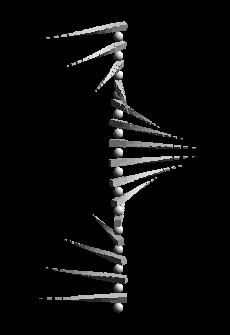 To:
To: 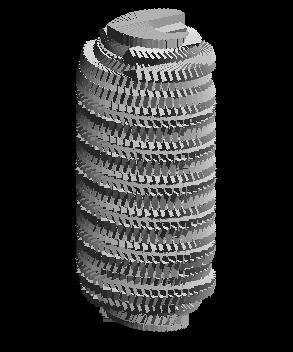
And if they ask for the details of the blueprint it is simple as that:
// MTL’s multi-story casino blueprint
a_spine=box < -87.0838 , -680.583 , 892.81 > stack -39.4158 in 1.6423% grow -581.552 twist -32767;
tweeny_bit = sphere ( 409.017 ) stack -36.4661;
tweeny_bit & [a_spine] stack -628.25 in 20.5538% twist -2123.08;
end;
Ok enough playing… now it’s time to get back to the reading…
Computing with Entropy
March 6th, 2005An interesting concept is entropy. Entropy is the tendency of things to become disordered and chaotic over time. For example, if you have a bottle of red dye, and a bottle of water, and you put a drop of red dye into the bottle of water, the red dye will start off concentrated, but then will slowly diffuse through the bottle of water, until the whole bottle is just a little bit more red. This same concept applies to everything: things are (in the long run) becoming more disorderd. Entropy is even used to determine which way time is going: time is going in the direction of increased entropy.
Now, as my ‘end of the universe’ post pointed out, we don’t have a way to reverse entropy. What’s fun to think about, is how we use things as they’re falling down the order ladder towards chaos. For instance, the sun fuses hydrogen together, and the universe loses a little bit of matter it will never recover, as it is converted into energy. Uncountably many times this happens, and those little photons travel about a hundred million kilometers to earth, and heat up some water molecules just enough, so they turn into vapor. The vapor rises, and collects into clouds, and then falls in rain or snow. The rain and snow collect in rivers, and eventually we dam some of them up, so we can let the water fall down a few hundred feet and turn a crank so we can excite some electrons and get them to start flowing. This flow we transmit hundreds of miles through transformers and wires, until it gets to our homes. At this point we push some of the electrons through little gates and switches (I can just imagine them sloshing through pipes) as they race towards chaos (in this case, the ground). So we turn them this way and that to fit with our abstract concept of ‘numbers’, and then depending how the electrons fall through our electron maze, we can say, “ah, 2+2 IS 4”, and then the electrons fall through the chip, into the ground wire and find a companion proton somewhere in the Earth.
At least as the universe falls towards chaos, we can use some of it to add!
The Facebook
March 2nd, 2005I felt it was inevitable that someone would post about facebook, so I decided it may as well be me.
Facebook is one of those things that really seems like a huge waste of time, because it is. It is essentially a university directory, where people go and enter in some information and maybe upload a picture of themselves. They then look through the directory to find people they know or have things in common with to add as friends or create groups with. That’s all it is: a fancy directory. However it seems to have taken a hold of some people in quite some fashion. I know some people who check it daily, and who have amassed these huge lists of acquaintances who they are ‘friends’ with. It is truly bizarre.
The members of McGill’s facebook seem to be primarily first and second year students, and seems weighted towards Americans and people who have stayed in residence at McGill. This is likely because Facebook started at Ivy League universities (Harvard to be exact), and slowly spread to other American universities, so when students at universities where facebook is already established notice that new universities have joined, they tell them to sign up so they can be added. Those students at McGill, coming from the states, often live in residence, and tell other people who live in residence about the site, they them sign up, and so on. I was told about it by an American student at McGill in mid-October. Diffusion at work.
I notice Hannah already has an account, but a quick search didn’t turn up any of the rest of the class, nor Prof. Sieber (I found 2 professors when I looked, one chemistry professor, and the other is in education and a residence director). To sign up you need your McGill e-mail address , which I was slightly worried about giving, but I haven’t noticed any spam coming in on my McGill e-mail since, and it’s not as though the e-mail isn’t available elsewhere on the web for bots to crawl.
Watch out, people seem to find it addictive!
future industry
March 1st, 2005I’m going to try and write a few more blogs this week to compensate for the ones I missed before the break. It has been so long I even forgot how to login! Someone mentioned something about 3D printers in class today and it reminded me of a slashdot blog I read earlier regarding a printer that makes sushi. Is there anything technology won’t be able to do in the future? Apparently the ink that is used is food-based and the paper is made of soy and seaweed. Can you see 3D printers being as common as personal computers in the future? Would they allow for customization of goods? Think of it – you wouldn’t have to step into another mall again – you could make your own custom barbie dolls as a gift for your little cousins, sitting at home!
E-Waste in Bangalore
February 25th, 2005From Madhav Badami, our professor of Urban Planning and Environment
Greetings all,
This is my first blog post ever. Actually, I was meaning to blog a couple of weeks ago, in response to the BBC news item on e-waste in the city of Bangalore in India. Unfortunately, I was laid low by an attack of acute tendonitis, and I have been back on my feet only the last three days (it is like being born again, I can tell you).
Before I proceed, I wish to declare my motivations for blogging on this particular topic. First of all, I have a strong academic interest in policy-making for waste minimization; and I am particularly concerned about the growing waste problem in low-income countries such as India (I will get to why in a bit). Secondly, and at least as importantly, I spent some of my best years living and working in Bangalore. So, this is a city I care about. Bangalore is situated on the Deccan Plateau in the south of India, and because of its altitude, enjoys year-round temperatures that are significantly lower than in the surrounding plains. I have been visiting the city ever since the 1970s, and I can even now recall how very beautiful it was then — lots of greenery, broad sidewalks, and very clean (unlike many other Indian cities). And although it has deteriorated considerably because of rapid urbanization in the last couple of decades, it is even now considered to be India’s Garden City.
Now, about the changing waste situation in India. India began liberalizing its economy in the early 1990s, and ever since then, urban incomes and consumption have increased dramatically. Not only has consumption increased, the kinds of things that are consumed (and discarded) have changed as well. For example, electric household appliance use has grown by leaps and bounds (and so has energy consumption). Western fast foods, with all that they entail, have become popular, and the amount of packaging has increased. And so, just as consumption has changed (both in terms of quantity and quality), so also has waste. Waste in Indian cities used to be predominantly organic (food, yard wastes, and so forth), with very little non bio-degradable stuff, such as plastics. Recycling rates were very high, and the bulk of the recycling was done informally. For example, a chap would come to our house (and every other house in the neighbourhood) once every two weeks or so, on a bicycle, and pay to take away all the newspapers, and any bottles and cans that might have collected since his last visit. The newsprint would be (and still is) converted into packets for groceries, vegetables, and snacks. Very little was allowed to go waste. The only thing that was thrown away was food leftovers. Incidentally, most Indian households use stainless steel utensils and cutlery that are handed down from generation to generation (we do too, in Montreal, and many of our stainless-steel vessels come from my wife’s and my parents). And milk was typically collected in a stainless vessel in the morning, from the local dispenser (earlier, when I was a child, it used to be brought home by the local milkman, on his bicycle. )
But with the rampant consumerism in the 1990s, the amount of waste generated has increased, and the composition of waste has changed, as discussed. The share of non-biodegradable materials, and materials that either cannot be recycled or are very difficult to recycle, and hazardous wastes in the waste stream has increased significantly. Enter the computer industry. Simultaneously with liberalization in the early 1990s, the computer software industry started booming, mainly in Bangalore; this was in large part because over the past four or five decades since India gained independence, Bangalore had been the centre of several manufacturing and hi-tech industries (earth moving machinery, aircraft, electronics and telecommunications, precision equipment, and so forth), and the centre of higher education in the sciences. As the computer industry in Bangalore grew, it began to attract many major foreign multi-national computer firms (IBM, Sun Microsystems, and Oracle, to name a few). The city also became the headquarters of giant home-grown multi-nationals such as Infosys and Wipro. So much so that Bangalore has come to be known as India’s Silicon Valley. With this of course has come the problem of computer wastes that the BBC article talks about.
It is bad enough that municipal waste has been increasing dramatically in Bangalore and other Indian cities. These cities were already finding it difficult to cope, given the lack of infrastructure for waste collection and safe disposal. But the growth in computer wastes, and wastes from, for example, discarded mobile phones — it is estimated that two million units are being added every month, month after month, in India — has made a difficult problem significantly worse; and to add insult to injury, a lot of the computers used by people like us in the West end up more often than not in South Asia (and China), after we are done with them. All in all, a waste crisis. This is because many of the wastes from computers, mobile phones and other electrical appliances are hazardous, and if not treated and disposed of properly, can leach into groundwater and travel up the food chain.
As long as consumption levels were low, and the bulk of the waste was bio-degradable, the fact that infrastructure was inadequate was not a problem. But as the waste stream has become more complex and dangerous, more and more sophisticated and expensive technological systems and regulatory regimes are required to collect, treat and safely dispose of waste (note that sanitary landfills, for example, involve millions of dollars to construct, operate and maintain). Indian cities, given their meagre resources and multiple urgent priorities, simply do not have the wherewithal to put in place such measures. Also, as long as consumption levels were low, the population of Indian cities was not a serious problem. But just imagine the situation when you have 10-15 million people (as you do in some Indian cities), a rapidly growing number of whom are beginning to consume like North Americans, but with nowhere near the ability of North American cities to deal with the waste generated.
I would like to close with this one final point. The advent of the computer and software industry in Bangalore and other Indian cities has undoubtedly produced many socio-economic benefits — among other things, it has created tens of thousands of high-paying jobs, and generated vast revenues to the exchequer by way of corporate taxes, and billions of dollars of foreign exchange reserves. At the same time, it is causing negative environmental impacts, of which computer wastes are only one. With the growing incomes has come dramatically increased motor vehicle ownership and use, causing major traffic congestion and air pollution, and severely straining the already inadequate road infrastructure. And many low income people have been squeezed out of the land markets within the city, and have had to locate in the periphery, in areas not well served by transit, as real estate values and rents have sky-rocketed (it would be interesting to consider if a manufacturing industry with similar employment levels as the computer industry and located in the outskirts, would have had this effect).
Your virtual girlfriend
February 25th, 2005Cyberspace meets meatspace, in the form of your new virtual girlfriend, Vivienne. Developed by Artificial Life, Inc, Vivienne can converse in 7 languages and can move through 18 settings, such as bars, restaurants, shopping malls and movie theatres. She loves virtual flowers and chocolates that you can buy here. You can even marry her and get cell phone messages from her mother-in-law.
This is all done through your cell phone. According to the article, “Vivienne … is at the leading edge of a wave of services that companies are developing to take advantage of the much faster data transmission rates made possible by 3G technology.” It utilizes expert systems located on servers to handle the 35,000 topics that Vivienne can discuss, from philosophy to movies to sculpture to banking.
Apparently there are technical problems because the 3G cell phone batteries run down easily and there is no voice recognition (although she voices her responses, you have to text your requests). But consider the social problems.
Artificial Life has already run into delays in introducing Vivienne to men in Asia and Europe. It originally hoped to have her flirting on cellphone screens by last Christmas.
[However, there are cosmetic problems] -Vivienne is being reprogrammed not to bare her navel or display body piercings in conservative Muslim countries like Malaysia.
And the designers are worried that Vivienne’s boyfriends might become addicted to her so contact will be limited to one hour per day.
Now I can hear the guys thinking out there, “if only I could limit my conact with my girlfriend to one hour per day.” Or “if only I could get a girlfriend willing to ‘respond’ for a few virtual flowers or movie tickets.” Will we have lots of virtual hookups because they’re more efficient, giving us what we desire, instead of the more messy reality? From the success of certain types of chatrooms, I think the answer is yes.
Population estimate
February 25th, 2005Here is a story from AP via the Globe about the UN population estimate for 2050: 9 billion people and mostly in the developing world. Just imagine the earth’s population almost doubling over 45 years, that’s an incredible increase compared to what we have recorded to now. What will the implications be for nature of this population growth? How can technology assist with dealing with population growth?
Friday Cat Blogging (the North-South Edition)
February 25th, 2005
Starving Venezuelian mother enjoying the gift of Quebec tourists. Tuesday 22 Feb 2005, Margarita Island, Venezuela. Courtesy Prof. Frederic Fabry, School of Environment and Atmospheric and Oceanic Sciences
Maldives Pushes Ahead With Relocation Plan…
February 25th, 2005What has been anticipated as now begun… the relocation of islanders.
Yesterday in the news they announced that the Maldives is going ahead with its relocation plan.
The Tsunami has obviously given the spark to Maldives to go ahead with the relocation plan, 40% of the country’s land have been submerged during the tsunami, but the real-problem of the island nations (we all know it) is the rise of ocean due to global warming. The Maldivian government plans to relocate 60% of its people from low-ground islands to higher ground islands.
Maldives have at least some higher-ground to relocate its people but it is not the case for another country with an even more critical situation, Tuvalu.
Tuvalu is a small country in the south pacific composed a a few coral islands, its highest ground is not more than 4.5metres above sea-level. More and more often Tuvalians see their whole country flooded during “king tides” that can reach more than 3 metres above normal sea-level. The last one was two-weeks ago. Tuvalu’s government is now trying to dress a relocation plan with Australia and New Zealand in case of an emergency.
I liked the analogy that the government of Tuvalu does between the “War on terror” and “climate change” in terms of national security.
QUOTE=>
Tuvalu said it understood that for many countries, particularly developed nations such as the United States, national security was now a priority and the island nation supported the war on terror.
Tuvalu representative Enele Sopoaga told the General Assembly that national security was also a priority for Tuvalu, but the threat it faced was not from terror groups or weapons of mass destruction but climate change.
“For Tuvalu and many small-island developing states security should be seen in its multi-dimensional nature. Our national security is threatened by environmental degradation emanating from outside the country,” Sopoaga said.
“The impact of climate change has the potential to threaten the survival of our entire nation,” he said.
<= END of quote So which one are the most threatening WMDs? Sarin or CO2
Environmental IT Purchasing
February 24th, 2005An interesting link I ran across, it appears to be an environmental checklist by the chief technical officer for the city of Seattle. I find it reassuring that it even exists! It covers goes over how to make environmentally sensitive IT purchases, and has a sort of checklist for effective purchasing, including energy efficiency, toxic materials, percentage of recycled material, as well as how to deal with the computer waste.
Of course, this is a government agency (presumably) asking these questions, and one could argue whether a company driven purely by profit motive would have what seems to be a very reasonable set of criteria.
I can certainly imagine some change taking place if a few relatively large companies had this same set of criteria in their IT departments.