Anonymity Away!

June 6th, 2006

I came across the name of an old (relatively speaking I suppose) friend on the internet recently. As is standard procedure for me these days, I proceeded to put their name into Google, and was pleasantly surprised to find out that they had not only numerous hits in various communities, but a small personal webpage that they controlled.

People whose personal web pages come up while searching for their real name are typically what I would deem first class citizens of the internet: there are links to their contributions in online discussions or work, and you can both contact them easily, and with some work and a decent amount of background knowledge, get a good idea of their presence on the internet. For certain groups of people, the academic and tech communities come to mind, having insignificant-to-no results on a Google search immediately generates skepticism: where are the journal articles, the mailing list postings, the bug reports? You do not see such people being able to take part effectively in the discussions on most respected forums or blogs, RealClimate being one example.
If Google can’t find anything they’ve done, the question begs itself, have they done anything? While clearly the answer is generally yes, and the fault lies in the information not being available on the internet for search engines to find, there are generally few reasons for someone to allow themselves to be completely invisible on the internet. If you do not project a presence on the internet in a mildly significant and traceable way, it is difficult to contribute meaningfully to online projects: with no ‘credentials’, it’s tough to be taken seriously.

For a few years now, there have been options for those who didn’t have the technical wherewithal or time to bother setting up their own webspace, Geocities and Angelfire come to mind. Even with these tools, it wasn’t necessarily a fun or trivial task to put up a mildly decent website, and accordingly, only a small percentage did. With the bubble inflating once more, myspace and facebook (now the 4th and 28th most popular English language websites in the world respectively) would seem to vault millions of users into this first class citizenship. Now minor internet celebrities have links to their facebook or myspace profiles, and I have even seen such links proferred as evidence in defending online personas from accusations of ‘sockpuppetry’. Presumably the mild amount of time invested in the profiles of social networks websites provides a reasonable way to ensure that a unique legitimate person is behind each account.

It will be interesting to see where online communities go, greater dependance on the verifiability of participants, something that governments and those with an interest in monitoring activity on the internet would love, or a turn back towards near anonymity and its associated benefits and pitfalls.
baked alaska

May 30th, 2006

The USA Today has a fantastic multimedia presentation on the thawing of Alaska. In addition to a solid article on the subject, it shows an interactive graph of the temperature change (aka the hockey stick) from 200 A.D. – 2100 A.D. Move your mouse over the graph and you’ll see the what the temperature was/is/will be, how it was calculated, and what was happening at the time. For example, in 870 A.D., the average world temperature was 57 degrees (based on scientific analysis). During that time, the Mayan civilization was at its peak but eventually collapsed due to intense drought.

Click on the video player and you’ll see a map of Alaska and three small videos that illustrate retreat of glaciers, impacts on permafrost (including what permafrost is), and impacts on the forest as the summers get warmer. As each brief video plays, the locations appear on the background map.

I’m not normally a fan of the “McPaper” and the reporters are a bit too even-handed with the little ice age arguments (which translates as, “there’s some microscopic doubt that humans are causing climate change but let’s overinflate the counterargument so as not to upset the conservatives”). However, this elevates my respect of the paper. It’s an excellent presentation and well-worth a visit.

future of virtual environmental activism?

May 29th, 2006

I note with interest today’s NYTimes article on MTV’s entry into shows produced for cell phone screens. I don’t know how they’ll do with music videos, as the article points out, there’s significant pixel smear in image movement, which worsens with reduced streaming rates. But this might actually work with Flash activism, that has  slightly cruder animation, and short shows that contain lots of relatively static images. Think the Meatrix on your cell.

your 15 minutes of fame with climate change models

May 24th, 2006

Britain’s Open University and The British Broadcasting Company, BBC have teamed up to produce a series of documentaries on climate change. They will be hosted by veteran BBC nature documentarian, David Attenborough. The BBC links to a downloadable model that people can run on their PCs. (For more about the model see here and here). The results will be part of the documentary. Who knows, maybe your individual model run will be highlighted on the show.
Much information is available at a special section of the BBC site. The British news sites, BBC and Guardian have done spectacular jobs in educating the public on climate change. One wonders, what in the world is happening with North American news sites? Oh, that’s right, this much effort would suggest they’re taking a position on the science on climate change and we all know there’s conflicting evidence….

who knew Al Gore would be a celebrity?

May 23rd, 2006

I’ll let the entertainment reporters handle that one. Al Gore is at the Cannes Film Festival to promote his new documentary, An Inconvenient Truth, which offers compelling evidence for climate change. In the meantime the movie has a very nice web site containing a comprehensible digest of the science underlying climate change with RSS feeds of climate related articles and blog posts

coral reef bleaching on Google Earth

April 8th, 2006

The US National Oceanic and Atmospheric Administration (NOAA) has made its satellite images and environmental data on coral bleaching available on Google Earth. Now you can watch the coral reefs disappear on your laptop!

IM watching you

April 4th, 2006

Today’s Washington Post reports on the use of instant messaging (IM) to keep tabs on friends and relatives without necessarily using it for two-way communication. I like the bit about the potential to make IM locationally aware and combine it with GIS technologies:

Over time, companies such as Microsoft say they expect to pair location information with instant messaging, making it ever more possible for buddies to pinpoint a person’s physical and technological accessibility. AOL LLC’s AIM system, for example, already shows whether a person is logged onto instant message on a mobile device. Skype users with Web cameras can post icons to alert other users of their ability to video conference.

Not only are you constantly connected but constantly located. Add to this the cellphone and we always know what you’re doing and where you are.

This use of IM has interesting implications for surveillance. Does this constant accessibility — read, visibility — open the door for greater acceptance of Big Brother? “If all my friends know where I am and what I’m doing then it’s no big deal that government and business knows this too.”

fetch me my martini before the ice melts

April 3rd, 2006

In the latest issue of Science, researchers have combined a global climate model, a dynamic ice sheet model, and paleoclimatic data to issue new dire predictions on the rapidity of ice melt and water rise.

According to the Times UK, this is the first study,

to combine computer models of rising temperatures with records of the ancient climate [which] has indicated that sea levels could rise by up to 20ft (6m) by 2100, placing millions of people at risk.

Take a look at the whole issue of Science, dedicated to ice and climate change.

culture jamming and climate change

April 2nd, 2006

Chevrolet and Donald Trump’s The Apprentice teamed up to produce a website so that anyone can create their own ad for Chevy’s new SUV, the Tahoe. According to Autoblog, readers are able to choose from varied backgrounds, video shots, and input text to create their very own ads. I guess because they’re offering prizes Chevy thought all the ads would be “pro” SUV. They were very wrong.

Check out the ads before they’re taken down (my favourites are #1 and #6). Feel free to make one of your own.

my own research

March 26th, 2006

See the beta version of my new content management system, which contains information about my and my team’s research.

see glaciers disappear before your eyes

March 25th, 2006

New photos show that we don’t have to wait till some distant future to see the effects of climate change. Watch glaciers recede with your own eyes!

soaking up a bit of wi-fi could be illegal

March 25th, 2006

An Illinois county decides that piggybacking up on someone’s elses wi-fi is against the law.

David M. Kauchak, 32, pleaded guilty this week in Winnebago County to remotely accessing someone else’s computer system without permission, the Rockford Register Star newspaper reported. A Winnebago County judge fined Kauchak $250 and sentenced him to one year of court supervision.

I suspect that there are few war chalkers anymore. However, there may be lots of individuals who free ride on their neighbour’s Internet. I find this criminalization of Internet “entrepreneurialism” a bit creepy. Exactly what offense is this, sucking up radio waves? Aren’t we supposed to be cheering on innovative uses of the Internet as part of the new economy? Not to mention, this search for minor offenders takes away from looking for serious criminals.

This reminds me of the filmV for Vendetta. Will we have surveillance trucks patrolling our streets looking for the minor infractions? Call me paranoid (okay, I have been thinking about the movie too much), but what else can they listen for?

downtime

March 25th, 2006

Sorry for the site being down. I’m having my servers reconfigured. The site is likely to go down again as the database servers and the virtual machines get set up.

Now onto posting while we can!

Inside the volcano

March 19th, 2006

If you’ve ever wanted to know how vulcanology works, visit the virtual Alaska Volcano Observatory (AVO). Here you can see a history of the seismology, look at the web cams (even inside the volcano), and receive weekly reports on volcano conditions. You also can get information on how to collect an ash sample for AVO. This is a great use of the web for lay scientists and anyone who wants a user friendly introduction to the workings of a volcano.

ethics concern?

March 4th, 2006

Scientists are devising technology to remote control sharks on the high seas (seen in New Scientist). The plan is to use sonar to manipulate the shark’s brain signals, controlling its movements and possibly decoding its feelings. This technology is cited as being useful for understanding shark behaviours as well as having potential use for treating paralysis in humans. However, it is also mentioned that the research is being funded by the us military, who have designs for using the sharks as undetectable spies across the oceans…which seems to me to be severely ethically problematic. The pentagon’s ideas for sharks as “stealth spies” are a little more emphasised in the BBC article covering the topic (interestingly, the BBC also just posted an article discussing the problem of the media’s sensationalising of scientific stories…)

return of cat blogging

February 24th, 2006


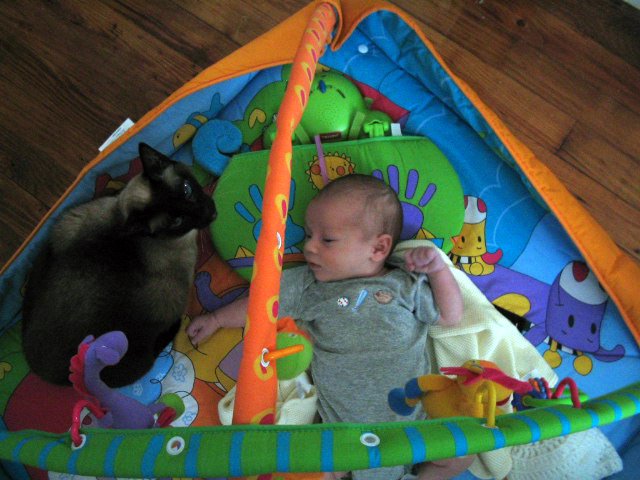
Zoe and the new Sideris-Crouch offspring. Safely ensconced in Indiana.

(Great pic, Robert. I can just hear the other parents screaming at the Internet. Keep that cat away from the baby! Let me assure everyone: that thing Zoe does with baby dolls, she’d never do with real babies 😉 )

wireless hazardous to your health

February 24th, 2006

Lakehead University, in in Thunder Bay, Ontario, Canada, has decided not to install wireless on campus because of health concerns.

The safety of chronic, long-term exposure to electromagnetic energy, of which radio waves are a part, is a hotly contested scientific subject. Researchers have conducted hundreds of studies assessing the health impacts of this form of energy, studying not only radio waves, but related topics, such as microwaves and the electromagnetic fields around electric wiring.

With the profusion of cellphone towers, wireless networks and electricity using electronic devices, exposure levels are rising rapidly across the globe.

But most studies have been unable to prove conclusively that common, everyday exposures are a health hazard. In response, regulatory bodies around the world have usually concluded that there is no reason for public concern.

The university instead will rely on and augment its existing fibre optic network. This actually handles some of the bandwidth problem experienced by universities. Increasingly students expect ubiquitous Internet connectivity — wherever you are on campus, you can connect. They don’t often connect their low bandwidth to the number of users on the network. However, this is becoming a huge strain on campus networks. Increasing capacity is expensive and university IT departments find all sorts of innovative ways to finance the growth, like downloading costs to neighboring academic departments. Wonder why tuition or user fees are going up? Here’s one reason.

Also, I appreciate the logical consistency of a university taking a stand on a health issue. Universities talk a lot about protecting the health of their student and staff population. Here they’re taking the precautionary principle under consideration and, in the absense of definitive evidence that the waves are safe, are being proactive. This step won’t make the administration a lot of friends. (Of course, it’s easy for me to say. I’m sitting here in the comfort of my own electromagnetic radiation…)

Read to the last paragraph.

computers that aid recycling

February 23rd, 2006

Not recycling computers but using computers to boost recycling. The idea is that you pay people to recycle. Computers are used to track that recycling and calculate the renumeration.

It’s called RecycleBank.

Households get credit for the weight of materials they recycle, which is scanned and recorded through a computer chip embedded in the garbage bins when they are picked up by the sanitation crew. They exchange that credit for coupons at various businesses. Municipal officials save disposal fees. Recycling companies make more money from processing. Retailers gain the feel-good association with a socially beneficial activity.

RecycleBank charges municipalities (or private haulers, depending on the arrangement) $24 a household, and guarantees clients that they will save at least that much in disposal fees as waste is diverted from landfills and incinerators. The company also receives revenue from recycling plants, depending on how much it increases the amount of materials that are processed.

The computer chip is a radio frequency ID, an RFID (apparently, the entrepreneurs found a company that already made bins with embedded RFIDs!).

The “smart waste” tag, a combination computer chip and bar code, enables the bins to be scanned and weighed and the amount linked to a household. The information is channeled from an on-board computer in the garbage trucks into a databank.

The Internet is used so that participating individuals can check their point balance online and obtain their coupons.

Now how about using computers to get people to recycle computers? Love that recursion.

Google Earth and tiles

February 19th, 2006

How does Google Earth work? Nature Magazine explains the “Short cuts [to] bring the globe to your screen without crashing your computer”.

Wikis on flu

February 18th, 2006

Check out the wiki that’s tracking bird flu. It’s an amazing resource that provides basic science and tracks the geographic spread of the disease. What someone needs to do is create a Google Maps version of this information.

On the subject of maps, the master site for bird flu maps is the eponymous birdflumap.com. There you can find out about the Google Earth layer for bird flu. Also, see the European Union site for decent maps.