abcnews goes green

May 10th, 2007

Tonight’s reporting from World News Tonight

* Concern Soars About Global Warming as World’s Top Environmental Threat
* How to Address Global Warming: A Range of Tips
* EPA Carbon Footprint Guidelines
* San Francisco Goes Green
* Shrinking Your Carbon Footprint
* Fixing the Planet for Profit
* Limit Your Impact on the Environment
* Check Your Household’s Carbon Footprint
* Reducing Your Carbon Footprint

carbon offsets for server farms

April 30th, 2007

We tend to focus on carbon neutrality for previous centuries’ industries (cars, coal). But we can forget the gluttonous material and energy needs of our e-industries. I’m thinking specifically of the acres of computer servers needed to support e-commerce functions and search engines. These server farms deserve our climate change attention just as much as our concern about SUVs. A couple of examples show that organizations are beginning to address these concerns.

Yahoo, for example, is aiming to go carbon neutral this year.

Carbon Neutral consults with firms to determine their carbon footprint, assess possibilities for reduction, and then estimate offsets. Some high profile organizations have used the company–IUCN is one–although I don’t know the Carbon Neutral’s provenance in terms of the carbon-friendly projects it funds.

Two Steps Forward succinctly lays out both the problems and advances of energy consumption by data centers.

I, for one, would like to determine how much offset I require for my home computers, although I realize that purchasing offsets doesn’t obviate my need for reducing overall energy consumption and computer use.

unintended consequences of alternate energy policy

April 27th, 2007

Renewable energy sources that reduce our dependence on oil and gas and decrease the emissions of green house gases may unintentionally do more harm than good.

In the rush to develop biofuels, forests are burned in Asia to clear land for palm oil, and swaths of the Amazon are stripped of diverse vegetation for soya and sugar plantations for ethanol.
….
The campaign [for sustainable biofuel standards] is driven by evidence that developers in the two Asian countries have burned vast tracks of rain forest to grow palm oil. The fires unleash millions of tons of carbon dioxide and smoke that shroud entire areas of Southeast Asia in eye-watering smog for weeks at a time.

The Netherlands is Europe’s biggest importer of palm oil, used in a wide range of supermarket products as well as a fuel oil supplement. One Dutch company has plans [as of 2005] to build three 50 megawatt power stations exclusively running on palm oil.

This is part of a hurried effort by The Netherlands to produce biofuels, which is not just an internal environmental decision but a reaction to stringent limits on carbon emissions imposed by the EU and a response to skyrocketing oil prices. To promote the use of biofuels, the Dutch government has created a basket of tax incentives. The government is rethinking the consequences of the push.

The Cramer Commission, which conducted the study, has recommended “a track-and-trace system to follow a [sustainably developed] product from plantation to power plant, like an express delivery package”. This may be a good test case for RFIDs. The original goods/packaging could be peppered with the minute ID tags. Enough should survive each step so the provenance of the goods could be determined. Not to say there wouldn’t be problems (e.g., diluting the ‘sustainable’ products with non-sustainable oil) but my experience with certificate programs suggests that they are quite difficult to enforce. Every bit helps.

clean green for the social elite

April 25th, 2007

Green cleaning products are the Tupperware of the upper class.

mobile phones and bees

April 17th, 2007

Bees are the key to most of the world’s food. Their seemingly minor act of pollination ensures most of the world’s food crops. In the past year, there’s been a dramatic decrease in North American and European bee populations where, in some places, up to 80 percent of them have simply disappeared. It’s called Colony Collapse Disorder (CCD), which

occurs when a hive’s inhabitants suddenly disappear, leaving only queens, eggs and a few immature workers, like so many apian Mary Celestes. The vanished bees are never found, but thought to die singly far from home.

Th collapse could be due to a wide variety causes, among them parasites, cancer, and even beekeeper practices.

New findings (reported here and here) suggest that the cause is related to cell phone usage. The radiation from mobile devices are interfering with the bees’ ability to home back on their hives.

If the massive bee die-off is due to mobile phones then researchers should be able to find out if it is due to specific radio frequencies. Meanwhile if the causal link is proven then shouldn’t all mobiles be turned off until a solution is found? That would cause a considerable uproar – but being able to feed people is more important. What if the link is associative (a clear link cannot be found but it’s strongly suggestive) or combinatorial (the radio waves in combination with something else is causing the losses). Then will the public give up their cell phones?

I couldn’t find the paper that the articles were referencing. The closest was this from 2004.

Update: Here are the symptoms of CCD

1) In collapsed colonies
# The complete absence of adult bees in colonies, with no or little build up of dead bees in the colonies or in front of those colonies.
# The presence of capped brood in colonies.
# The presence of food stores, both honey and bee bread
i. which is not immediately robbed by other bees
ii. when attacked by hive pests such as wax moth and small hive beetle, the attack is noticeably delayed.

2) In cases where the colony appear to be actively collapsing
# An insufficient workforce to maintain the brood that is present
# The workforce seems to be made up of young adult bees
# The queen is present
# The cluster is reluctant to consume provided feed, such as sugar syrup and protein supplement

This map gives you a sense of the huge impact of CCD in the U.S.:
bees.jpg
States reporting CCD in dark brown (March 2007)
(Map Source: Sieber. Data Source: Bee Alert Technology for the attributes and ESRI for the state boundaries)

[Got the idea for the map from the NYTimes, which treats explanations like cell phones as a form of wild-eyed conspiracy.]
Marrying-in is easy (and popular) with the Google family

April 12th, 2007

The number of extensions being linked to Google Maps/Earth/Etc. is incredible. The coffee-table atlas is virtually obsolete (no pun intended). For example, have you ever wondered where Anseba is located? Visit http://www.maplandia.com/eritrea/anseba/ for all you need to know.

google earth and darfur

April 10th, 2007

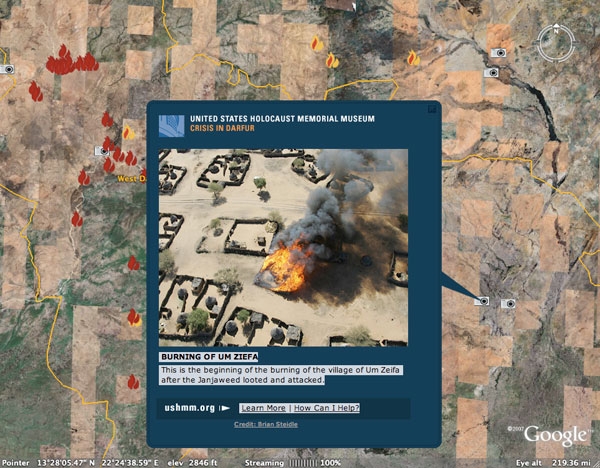
Google Earth teams up with the US Holocaust Museum to track the enormity of the first genocide of the 21st Century: Darfur in Sudan. There’s a wealth of information, both at the personal and the transnational scales. One can zoom in to see the stories of individual children or zoom out to bear witness to the sheer number of destroyed villages.

burning Darfur village

It would be an easy task to add geographic layers describing the public heath (e.g., water scarcity) and environmental devastation that often accompanies genocides.

grim visions

April 9th, 2007

Dire future from Britain’s Ministry of Defense, tasked with anticipating the challenge to its armed forces:

Information chips implanted in the brain. Electromagnetic pulse weapons. The middle classes becoming revolutionary, taking on the role of Marx’s proletariat. The population of countries in the Middle East increasing by 132%, while Europe’s drops as fertility falls. “Flashmobs” – groups rapidly mobilised by criminal gangs or terrorists groups.

Among the environmental problems they cite are water scarcity and climate change. All in all, it’s not too cheery.

google maps for communities

April 6th, 2007

Extreme Tech provides a detailed explanation on building your own community website by hacking Google Maps and Google Earth.

In addition to using GE and GM to build community sites for both community members and visitors, you could create an excellent green maps mashup.

Also check out GCensus on the same site, a way to create choropleth maps of census data, using Google Earth.

homeland security and spatial data–the local version

April 3rd, 2007

Santa Clara County, California has just decided to limit its sale of geographically related information, that is the data needed to make computerized maps. The stated reason is homeland security because “they didn’t want some of the data to end up in the hands of terrorists”. However, the county also just happens to be in the final phase of a lawsuit alleging that the county overcharges for its data. According to the report, the county currently charges $150,000 but a consultant hired BY the county asserts that the whole data set could cost as little as $22,000.

This is just the latest salvo in the fight by cities and counties to protect digital spatial data, whic represents a lucrative source of funding for the government (but also, to be fair, finances the county’s own geographic information system and staff, which historically has never been adequately budgeted for in more prosaic government operations). One should note that the collection of this data is financed by public dollars AND most of it is available for free in paper format. Should one believe I am making up ulterior motives, one of the plaintiffs in the case responds,

This is a completely made-up argument thrown in at the last minute,” he said, noting that the county had already sold the information and that employees without any kind of special training are allowed to work with it.

In the killer app world of Google Earth and Google Maps, this type of data now forms a critical part of standard government operating procedure. For example, private sector planners use it to assess the impacts of transportation proposals. Realtors use the data to sell homes. Corporations use it to select sites for new development. Availability of local spatial data possesses enormous importance as a window onto government activties, whether it’s police presense, environmental impacts, or affordable housing construction. That’s why the San Jose Mercury News is one of the plaintiffs and why nonprofit and environmental organizations should follow this case closely.

going down the drain

April 2nd, 2007

Environment Canada has just approved a Swedish toilet for use in Canada.

mulltoa-45.jpg

The Multoa, imported from Sweden, is a waterless composting toilet. More on the toilet from EcoEthic.

Update: If you need computational power, then try the eToilet, a joint venture between Microsoft and Mulltoa. Or if you require more efficient processing power, then I’d suggest the Mulltoa NE, which allows for batch composting.

please wash your hands before you surf

April 2nd, 2007

The Google TiSP. Another in a long line (here, here, and here for most recent) of our toilet-related posts.

going deep green

March 30th, 2007

A New York family vows to spend a year without toilet paper. It’s part of their experiment to exert no impact on the land — “eating only food (organically) grown within a 250-mile radius of Manhattan; (mostly) no shopping for anything except said food; producing no trash (except compost, see above); using no paper; and … using no carbon-fueled transportation.”

The family is blogging their progress on reducing their impact to zero. Wait a minute, using computers as a part of no impact? Neither the computer use nor the artistic/entertainment products of this year-long experiment goes unnoticed in their blog’s comment section:

“Getting people to read a blog on their 50-watt L.C.D. monitors and buy a bound volume of [their book] postconsumer paper and show the filmed doc [a friend is filming a documentary of the year] in a heated/air-conditioned movie theater, etc., sounds like nonimpact man is leading to a lot of impact.”

Still, this family’s experiment is a lesson for my students. Reducing your impact requires major lifestyle changes and is VERY time-consuming. Think on that if you live up 10 flights of stairs or have no refrigerator.

virtual Potemkin village

March 30th, 2007

The more we rely on online mapping to tell us the truth, the more it can be used to deceive us.

Google goes back to pre-Katrina maps, with the Lower 9th Ward restored.

Canary Islands gets censored data, which omits the beachfront development (since remedied)

Google Earth states that it uses whatever data that the data suppliers give them. But they certainly modify data based on government requests. So why not obtain “2007” data that actually is from “2007”?

pre-katrina.jpg
(screenshot of Google Earth, Lower 9th Ward, showing site of Industrial Canal levee break)

(yes, as posts show, I’m on a Google Earth kick.)

empowerment through maps

March 29th, 2007

My pal Dave Tulloch delves into the potential of empowerment and greater participation through online mapping.

He also points to the February 2006 cover article in the journal Nature, Mapping for the Masses.

Online mapping is the current killer app. What Dave and Nature leave out, probably because of space limitations, is the concurrent need for physical participation. We’ll have many new virtual tools to allow us to create individual empowerment (of course, it may be the appearance of empowerment). But it also can isolate us from members of our own geographic communities. That’s no substitute for the power of the group when it derives from people getting together in the same physical place to work out their differences and come to shared solutions.

3-D printing and Google Earth

March 29th, 2007

Google News reports on the use of 3D printers to produce physical topographic models:

The Dimension 3D Printing Group, a business unit of Stratasys, Inc., reports that Mitekgruppen, a Swedish design firm hired to create a 3D model of the city of Stockholm, Sweden, completed the project in a fraction of the normal time by using a Dimension 3D printer and Google Earth.

To construct the Stockholm model, Mitekgruppen used aerial photos and drawings to create the city’s buildings in a computer aided design (CAD) program. Where aerial photos and drawings weren’t available, designers relied on Google Earth to prepare these CAD files for the 3D printer. The CAD files were then sent to the 3D printer to produce models of Stockholm’s buildings. The finished building replicas where then positioned, secured and hand painted along with other landscape features including bridges, cars, boats trains and trees.

“A handmade model of this scale would have been a tremendous time investment,” said Martin Jonsson, co-owner and designer at Mitekgruppen. “Similar city replicas have taken years to construct. With the Dimension 3D printer and the images we gathered from Google Earth, a project that could have taken years to finished was completed in a matter of months.”

Other companies have used the Dimension 3D printer to create neighborhood models within cities. Gordon Ingram Associates (GIA), a U.K. based lighting consultancy firm, used a Dimension to generate scaled 3D models of areas in central London, allowing interested parties the ability to witness the effects of light on the buildings in the cityscape.

Here’s a description of 3D printing.

This would be an awesome tool for conservation projects in developing countries, the technological version of participatory 3D modelling.

Google Earth in Second Life

March 28th, 2007

Via Cyburbia, the blog on urban planning: Google Earth in Second Life

This is an interesting twist. Instead of making Google Earth into Second Life, why not make a virtual version of Google Earth inside of Second Life? Second Life is an alternative 3D universe (or Metaverse) which lets you have an alternate version of yourself and explore a different 3D world. Josh Knauer has developed a virtual version of a Google Earth like interface which he calls GeoGlobe. He announced GeoGlobe on his blog here. You need to have Second Life installed, and then follow this special link to teleport yourself into Second Life to let you view content such as Google Earth’s KML placemarks or GeoRSS.

Never thought I’d see recursion in virtuality. Question is, while the Second Life avatars are wandering GeoGlobe, will they be able to bring up Google Earth on their virtual laptops or handhelds?

mobile commerce for community economic development

March 21st, 2007

From time to time, I’ll write about opportunities for information technology to advance community development. How do you encourage local economic development when so much of your populace is excluded from mainstream financial institutions? Kenya has become the first country to allow cell phone users to send cash to other phone users via text messages.

Update: lest you think that mobile phones would be largely out of reach of poor Kenyans, here are some statistics from the article:

19% Adult Kenyans with bank accounts

54% Adult Kenyans with a mobile phone or access to one

another GIS for social change

March 20th, 2007

This time from the UK:

Helveta Ltd, a UK company, has developed an innovative software application called CIEarth, which is designed to enable accurate forest inventory and community resource mapping. The software is loaded onto a ruggedised handheld computer, data points are recorded via the touch-sensitive computer screen and the position of each data point is mapped according to its GPS location.

visualizing mountain destruction through google earth

March 19th, 2007

Appalachian Voices uses Google Earth to highlight the destruction of its mountain tops.

The first time I flew over southern West Virginia and saw mountaintop removal coal mining from the air, I knew that if everyone could see what I had seen—mountain after mountain blown up and then dumped into streams in the neighboring valleys—they would think twice about where their electricity came from the next time they flipped a light switch.

That’s why we at Appalachian Voices, and our partner groups, created the National Memorial for the Mountains, using Google Earth to tell the stories of more than 470 mountains that have been lost, as the centerpiece of our website www.iLoveMountains.org. We never imagined that those stories would now be available to over 200 million people as part of the latest release of featured content in Google Earth.