Javascript is required to view this map.

The Participatory Geoweb for Engaging the Public on Global Environmental Change

The Geospatial Web (Geoweb) emerges from the combination of Internet technology, geographic information, and social networking. As part of the second-generation World-Wide Web (Web 2.0), the Geoweb has the potential to address the crucial issues of our time, such as global environmental change. In this project we employ the Geoweb to stimulate, mediate, facilitate, and advocate public understanding, engagement, and action towards a sustainable development of the nature-society system. The project team seeks to examine what defines effective participation through the Geoweb, contextualize observations and opinions on environmental change, and develop a technical and policy infrastructure to support climate change response and adaptation. Our research approach includes a case study laboratory, in which experiments are conducted in partnership with different levels of government and non-profit organizations across Canada using a diversity of geographic and social scales as well as a variety of Geoweb technologies and applications.

Interview with Dr. Johnson Quebec Geoweb Research Project


In this podcast-video, Sophia an undergraduate environmental studies student at McGill University interviews, Dr. Peter Johnson a post-doctoral fellow at McGill University about his research. Dr. Johnson draws on his work in Quebec working with several government agencies, and specifically in the rural region of Acton vale to illustrate both the challenges and opportunities of these geospatial technologies in decision-making and citizen engagement.

Interview with Dr. Nama Budhathoki: Government Adoption of VGI


In this interview, Dr. Nama Budhathoki a post-doctoral fellow at McGill University discusses his research into the opportunities and challenges of government utilizing volunteer geographic information through the GeoWeb. He explains that there is enormous opportunity for governments to engage with the public through digital tools that spatially communicate information. Challenges remain that include closing the wikipedia, June 29, 2010: "the gap between people with effective access to digital and information technology, and those with very limited or no access at all. It includes the imbalance both in physical access to technology and the resources and skills needed to effectively participate as a digital citizen." For us, the digital divide includes access to a range of platforms, from Internet to mobile technologies. It includes the availability of data to make effective use of those technologies (e.g., a coarse resolution digital background on Google Maps may make it difficult to effectively use that technology).">digital divide, assessing data quality and potentially violating citizen privacy.

Interview with Pierre Beaudreau: Developing Geoweb Tools with Government


In this interview, Pierre Beaudreau a third year undergraduate in Geography discusses how municipal governments are looking to use GeoWeb tools for rural development and to increase public involvement in decision-making. Drawing from a partnership project with the rural municipality of Acton Vale, Quebec, he explains the Geoweb, its function, motivation and challenges associated with government adoption along with his own challenges in developing interactive web tools with government.

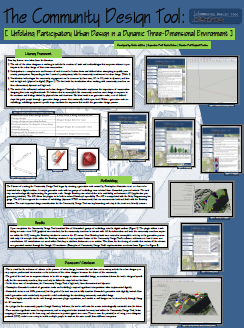
GeoWeb Summer Series 2011: Interview with Korbin daSilva


In this interview Korbin daSilva discusses his Masters research on Participatory Urban Design and how the use of 3D tools, such as his Community Design Tool can provide a way for citizens to more effectively partake in the process of designing sustainable neighborhoods through government to public participatory processes

Congratulations to our award winners!

in

Congratulations to the winners of the Open Source GIS (OSGIS) Open Nottingham Best presentation awards 2011. Our team members won one of the three awards:


Mapping Across Borders: Facilitating Open Source GIS training through micro volunteering

Michael Martin and Jon Corbett

The Centre for Social Spatial and Economic Justice,

The University of British Columbia


Team Meeting Year 3 Kick Off

Our annual team meeting happened this year, May 18 -19, 2011, at Ryerson University following the GEOIDE Scientific Conference. Twenty students and network investigators attended as well as guests from the GEOIDE Network. The objective was to provide a space for our team to update each other on projects and at the same time establish our goals for the coming year. All nodes were well represented and participated in a fruitful review of team-wide accomplishments. We were able to identify significant findings that apply across the nodes. Here is a list of some of our top findings:

1)    Community groups are more likely to contribute and use VGI compared to the institutional or government level. Higher levels are willing to participate through using community groups as an experiment due to less liability and certain obligations for accessibility of their own data.

2)    Government adoption of the Geoweb is enabled or disabled by the level of data verification desired.

3)    Geoweb tools currently mismatch with current processes and may require a new approach. Consider that many of these emergent tools are being applied to status quo and existing structures and processes. (ex. city planning procedures).

4)    The Geoweb may have a global scope of viewers but hyper-local contributors. Most of the contributors are local even when there is large number of transient persons visiting the location. Related to Nama’s finding in OSM-pride of place sustains contributions.  However, others feel it is more about belonging to a community of interest (space), rather that a specific place, dictated by geographic boundaries.

5)    Geoweb promises simplicity and little training, the reality is it is complex to develop functional tools and to use them.

6)    Volunteer users tend to be of a certain demographic; mode of interaction is hard-wired.

7)    There is a need to increase spatial literacy. Geoweb allows for a social network of peer to peer training and current platforms encourage innovation. Reality is many groups require offline training to enable VGI contributions.

8)    Citizen science needs to be as good as expert science, to be used in decision-making. Attempts to do this include mitigating the approach to VGI, such as identification questions or expert verifications of wildlife sightings (ex. nlnature or biology atlas).

A central priority, identified before the meeting was to establish a publication plan for the year. Day 2 focused on a writing workshop to enable the forming of manuscripts across the team. The themes identified were:

1) Best practices to promote engagement; design principles; outcomes;

lessons learned (e.g. sustainability)

2) Social evolution of projects (e.g. expectations, ownership of users)

3) How do we evaluate tools & projects (methods framework); citizen

"science" on the Geoweb; data quality on the Geoweb.

4) Variations in user communities; who is the user; leadership within

community.

5) Toolbox for addressing challenges in spatial literacy; examples of

when challenges occur.

6) Typology of technological development.

These themes guided the process of developing the paper outlines with the researchers grouped in appropriate authorship teams. Year 3 will continue with follow-up conference calls and work on these publications. It is a busy and exciting year ahead for GEOIDE Team 41.

The Geoweb and the Rural Digital Divide


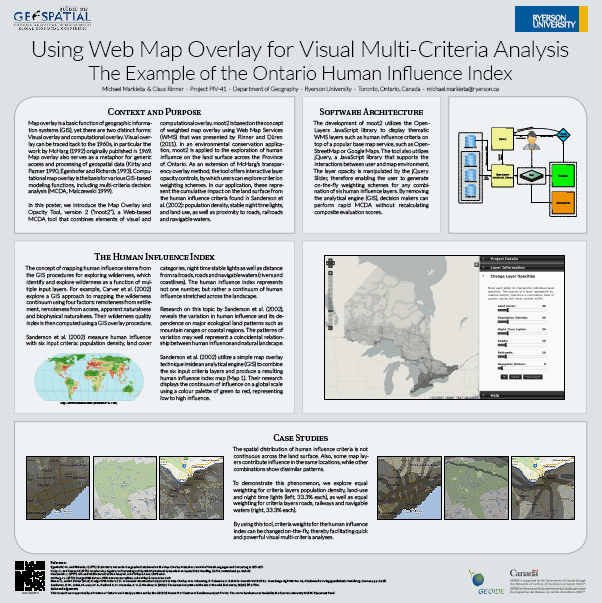
McConchie, Klinkenberg poster at GEOIDE

GEOIDE poster abstract: Interactive User Validation of Volunteered Geographic Information

Authors: Alan Mc Conchie, alan dot mcconchie at geog dot ubc dot ca and Brian Klinkenbergbrian at geog dot ubc dot ca

Department of Geography, University of British Columbia

Efforts to encourage the submission of Volunteered Geographic Information (VGI) must be tempered by the realization that unless some form of quality control is enabled the resulting information might be discounted by many who potentially could make use of such information, such as government departments.  An effective quality assurance (QA) process, while enforcing some form of oversight on the submission of information, could, at the same time, provide feedback to the users that encourages them to become even more involved volunteers.

In this poster, we illustrate our work in progress to develop an interactive validation system for VGI of invasive plant species in British Columbia. Using existing species records and ecological parameters, we have developed maps that delimit the potential range of each species, and and thus determine the likelihood that a new submission is valid or not. Based on whether a record is a geographic or ecological outlier, our system will either provide suggestions for alternative species (e.g., "could you have been looking at species Y, which looks similar to species X, but occurs at higher elevations?") or note that their record represents a significant range expansion and therefore is an important observation that would benefit from additional information. Ultimately, the volunteer receives feedback that enables them to judge the validity of their information, and encourages them to learn more about their environment.


Poster to follow

Team 41 at the GEOIDE Conference

Several graduate and undergraduate students represented Team 41 at the 2011 GEOIDE Annual Conference held this year in Toronto on May 16th and 17th:

  • Lukanyenko, Roman. 2011. Citizen Science 2.0: Increasing quality and participation. Poster presented at the 2011 Annual GEOIDE Conference May 16-17, Toronto.
  • Torio, Dante. 2011. Using Fuzzy Logic to Map the Threat of Coastal Squeeze in Marshes at Wells Reserve and Portland, Maine. Poster presented at the 2011 Annual GEOIDE Conference May 16-17, Toronto.
  • Tudge, Pamela. 2011. Participatory Geoweb: Communicating Climate Change Report for Year 2. Presented 2011 Annual GEOIDE Conference May 16-17, Toronto.
  • Walker, Blake, and Claus Rinner. 2011. Deconstructing Effective Participation on the Geoweb. Poster presented at the 2011 Annual GEOIDE Conference May 16-17, Toronto.
  • Zhou, Jian. 2011. A Debate on Using Climate Models: Is it Crazy or Not?.  Presented at the 2011 Annual GEOIDE Conference May 16-17, Toronto.

Team 41 students Blake Walker and Steven Chung also served on administrative roles during and after the conference: Blake moderated several conference sessions in his capacity as coordinator of the GEOIDE Student Network; and Steven was the coordinator of the GEOIDE Summer School that followed the conference.


Syndicate content